 Best
BestDisclosure: We are reader-supported. If you purchase from a link on our site, we may earn a commission, Learn More
Deel Review 2026: What Changes When You Run Global Employment Through Deel
At a certain stage of growth, hiring globally stops being the difficult part.
Paying people correctly becomes the constraint.
Not in the simple sense of sending money across borders, but in the structural sense of doing it legally, repeatedly, and without accumulating operational risk in the background.
That is the category Deel occupies. Not as payroll software in the traditional sense, but as a layer of employment infrastructure for distributed companies.
The interesting question is not whether it functions.
It does.
The more relevant question is what kind of organization it gradually turns you into once it becomes part of your operating system.
The real problem is not hiring — it is employability across borders
Global hiring is often described as a talent acquisition problem.
 In practice, it is a legal and administrative compatibility problem.
Finding a designer in Argentina, a developer in Poland, or a marketer in Singapore is operationally easy today. The friction begins after the decision to hire.
Because each country introduces constraints that most companies are not structurally prepared to handle:
- local employment classification rules
- tax registration requirements
- mandatory benefits frameworks
- payroll reporting obligations
- legal entity requirements
These are not problems that scale linearly. They multiply.
Historically, companies solved this in one of two ways:
- Set up legal entities in each country
- Avoid hiring internationally until necessary
Both approaches slow expansion.
Deel exists to remove that decision point entirely by abstracting employment infrastructure.
Employer of Record: the invisible operating layer
The Employer of Record (EOR) model is where the system actually changes shape.
Through this structure, Deel becomes the legal employer in countries where your company does not exist legally.
Your company still directs the work. The employment relationship is routed through a third-party legal entity.
On paper, this is straightforward.
In practice, it fundamentally changes how hiring decisions are made inside an organization.
What changes operationally
Without EOR, each international hire triggers a sequence of dependencies:
- legal review
- contract localization
- compliance verification
- onboarding timelines tied to jurisdiction
- payroll setup per country
With EOR, that sequence collapses into a standardized workflow:
Hire → contract localized → payroll executed → compliance handled externally
The key shift is not speed. It is predictability.
You stop treating each country as a separate operational project.
Instead, you treat global hiring as a repeatable process.
A practical scenario
A typical distributed startup might want to hire simultaneously in three regions:
- a backend engineer in Eastern Europe
- a designer in Latin America
- a growth marketer in Southeast Asia
Without EOR, each hire becomes a parallel legal effort. Timelines diverge. Costs vary. Internal coordination becomes fragmented.
With Deel’s EOR model, onboarding becomes synchronized.
Not identical in legal structure, but uniform in execution flow.
The trade-off
This abstraction comes with a structural consequence.
Instead of investing in internal employment capability, companies shift toward a recurring cost model.
At early stage, this feels like efficiency.
At scale, it becomes a permanent line item tied directly to headcount geography.
The hidden decision is not “should we use EOR?”
It is “how much of our workforce do we want permanently externalized from our legal infrastructure?”
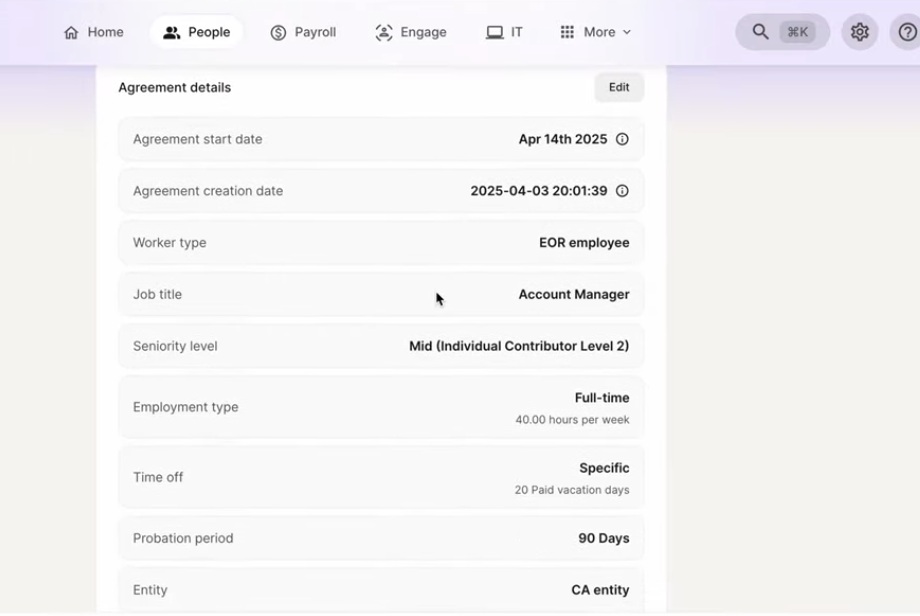
The Deel EOR interface reflects this abstraction clearly. Agreement structures are standardized, with role, employment type, and compliance elements presented in a fixed format. What appears as simplicity on the surface is actually enforced consistency across jurisdictions.
Global payroll: consolidation without full control
Beyond EOR, Deel functions as a global payroll layer for companies already operating across multiple entities.
This is where expectations and reality sometimes diverge.
What Deel provides is not deeper control over payroll systems. It is consolidation of visibility.
Finance and operations teams gain a unified view of:
- payroll across multiple jurisdictions
- workforce cost distribution
- multi-currency payouts
- centralized reporting
In fragmented setups, this visibility alone is a meaningful upgrade.
However, consolidation does not eliminate complexity.
It reorganizes it.
What still remains external
Even with Deel in place:
- FX costs still exist
- local payroll exceptions still occur
- regulatory differences are still enforced per jurisdiction
- edge cases still require manual intervention
The system reduces fragmentation, but does not fully internalize control.
Where this matters most
For mid-stage companies, this trade-off is acceptable.
For larger organizations, especially those with finance-heavy operations, the limitation becomes more visible:
Deel simplifies coordination, but does not replace deep financial infrastructure control.
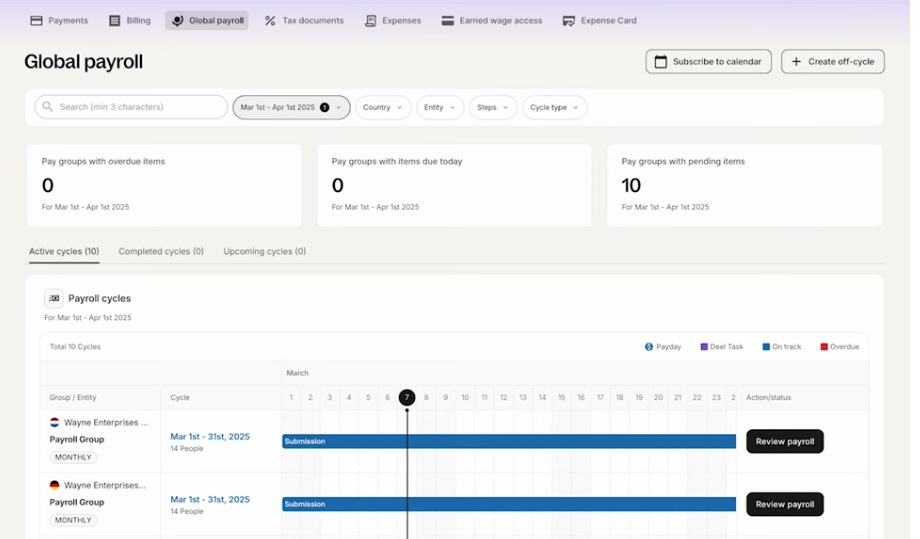
The Deel Global Payroll dashboard reinforces this model of consolidation. Payroll cycles, pending actions, and timelines are centralized into a single view, reducing fragmentation. The value is not deeper control, but clearer visibility across distributed operations.
Contractor management: the entry point that creates dependency
Most companies do not begin with EOR.
They begin with contractors.
And this is where Deel becomes embedded most quickly.
Before structured platforms, contractor management tends to evolve organically:
- invoices handled manually
- inconsistent payment timelines
- informal classification rules
- onboarding varies by team or region
Deel standardizes this layer into a single system.
Contracts are generated based on jurisdictional logic. Payments are structured and scheduled. Compliance classification is embedded into workflow.
The immediate benefit is consistency.
The longer-term effect is dependency.
Because once contractor workflows are centralized, reversing them introduces operational friction that most teams avoid.
The constraint that appears later
As contractor volume grows, some limitations become more visible:
- reduced flexibility in contract design
- standardized workflows that resist customization
- dependency on platform-defined payment structures
- integration gaps with internal accounting systems
The system works best when repeatability is the priority.
It becomes less adaptable when edge cases begin to dominate operations.
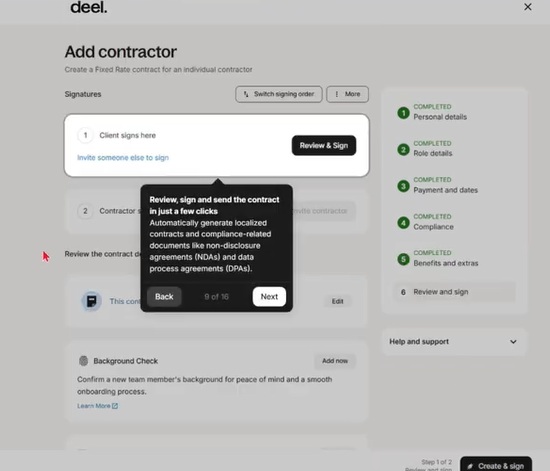
The Deel contractor management workflow follows the same principle of standardization. Onboarding, compliance checks, and contract execution are structured into a guided sequence, limiting variability while ensuring consistency across regions.
User experience: designed for correctness, not exploration
The interface is often described as clean.
A more accurate description is constrained by design.
Every workflow inside Deel is optimized for reducing ambiguity rather than enabling flexibility.
- onboarding flows are linear
- approval chains are explicit
- actions are compliance-validated
- system paths are predefined
This reduces operational error in a domain where mistakes carry legal consequences.
But it also shapes behavior.
Teams operate within predefined structures rather than designing their own.
For early-stage companies, this is beneficial.
For mature organizations with complex workflows, it can feel restrictive over time.
Support and reliability: where abstraction is tested in real time
In payroll infrastructure, support is not a peripheral feature. It is part of system reliability.
Because when something breaks, it is rarely cosmetic.
It often affects compensation cycles.
Deel generally performs well in structured scenarios:
- onboarding support is consistent
- documentation is comprehensive
- enterprise accounts receive dedicated coverage
Where variability appears is in edge cases:
- multi-jurisdiction payroll anomalies
- urgent escalation paths
- resolution timelines for complex compliance issues
This is a natural consequence of outsourcing employment infrastructure.
You are not just outsourcing execution.
You are partially outsourcing recovery when execution fails.
Pricing: what companies are actually buying
Deel does not compete on cost efficiency.
It competes on replacing internal capability requirements.
 The pricing model effectively bundles:
- legal employment infrastructure
- compliance management across jurisdictions
- payroll execution systems
- administrative overhead reduction
- speed of global hiring expansion
Viewed this way, it is not a software subscription.
It is access to distributed employment infrastructure.
The strategic implication
At early stages, this feels like operational leverage.
At scale, it becomes part of the company’s fixed global hiring structure.
And at that point, optimization questions begin to shift:
Not “is this expensive?”
But “how much of our workforce should sit inside this model versus outside it?”
In most cases, the real comparison is not between Deel and another tool, but between:
- building internal employment infrastructure across multiple countries
- or using a platform that standardizes and absorbs that complexity externally
Pricing varies depending on country, employment type, and structure. So the more meaningful evaluation is not the absolute fee, but the operational burden it removes.
Where Deel fits in the broader market
Deel operates in a category that is still forming: global employment infrastructure.
It does not compete directly with traditional payroll systems.
It competes with:
- building legal entities in multiple countries
- fragmented local payroll providers
- internal compliance teams
- regional HR infrastructure
Its advantage is execution speed and coverage.
Its limitation is structural standardization across inherently variable systems.
When it works — and when it becomes a constraint
Deel is most effective in environments where:
- international hiring is accelerating
- speed outweighs optimization
- compliance risk needs to be minimized
- teams are distributed by default
It becomes less optimal when:
- global operations are already mature and stable
- internal legal infrastructure exists
- cost efficiency becomes the primary constraint
- workflow customization is critical
Final verdict
Deel is not simply a payroll product.
It is a decision about how a company wants to scale globally.
Specifically, whether it wants to build employment infrastructure internally, or operate on top of one that already exists externally.
That distinction explains its value and its long-term implications.
Because once adopted at scale, it does not just simplify global hiring.
It reshapes it into a standardized, externally managed system.
For companies optimizing for speed, distribution, and operational simplicity, that is often exactly the point.
For others, it eventually becomes something they begin designing around rather than through.
Try Deel
If you are evaluating how to structure international hiring or contractor operations, the real signal comes from live usage rather than comparison.
Start small: one contractor or one EOR hire in a new region.
That alone usually reveals more than any feature breakdown ever will.
Book a free demo to explore Deel Global Payroll in practice.
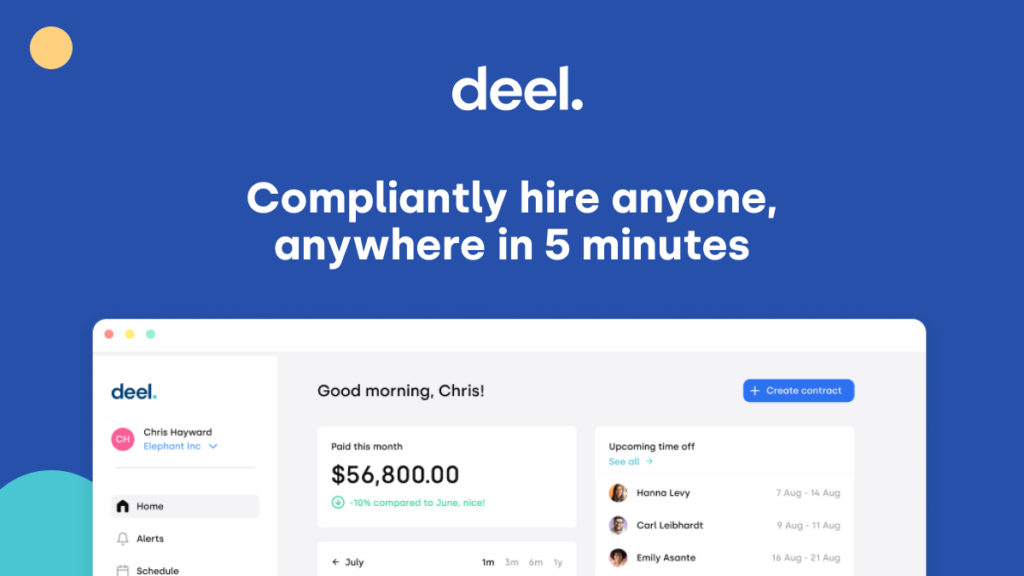
Hire Anywhere, Without the Hassle
Global hiring can be complex, with legal, payroll, and compliance challenges slowing businesses down. Deel simplifies the process by providing an all-in-one platform to hire, manage, and pay international talent quickly and compliantly. It removes the risks and operational burden, allowing companies to scale globally with ease.