 Best
BestDisclosure: We are reader-supported. If you purchase from a link on our site, we may earn a commission, Learn More
The Classification Trap: Why a Contractor Agreement Doesn’t Make Someone a Contractor
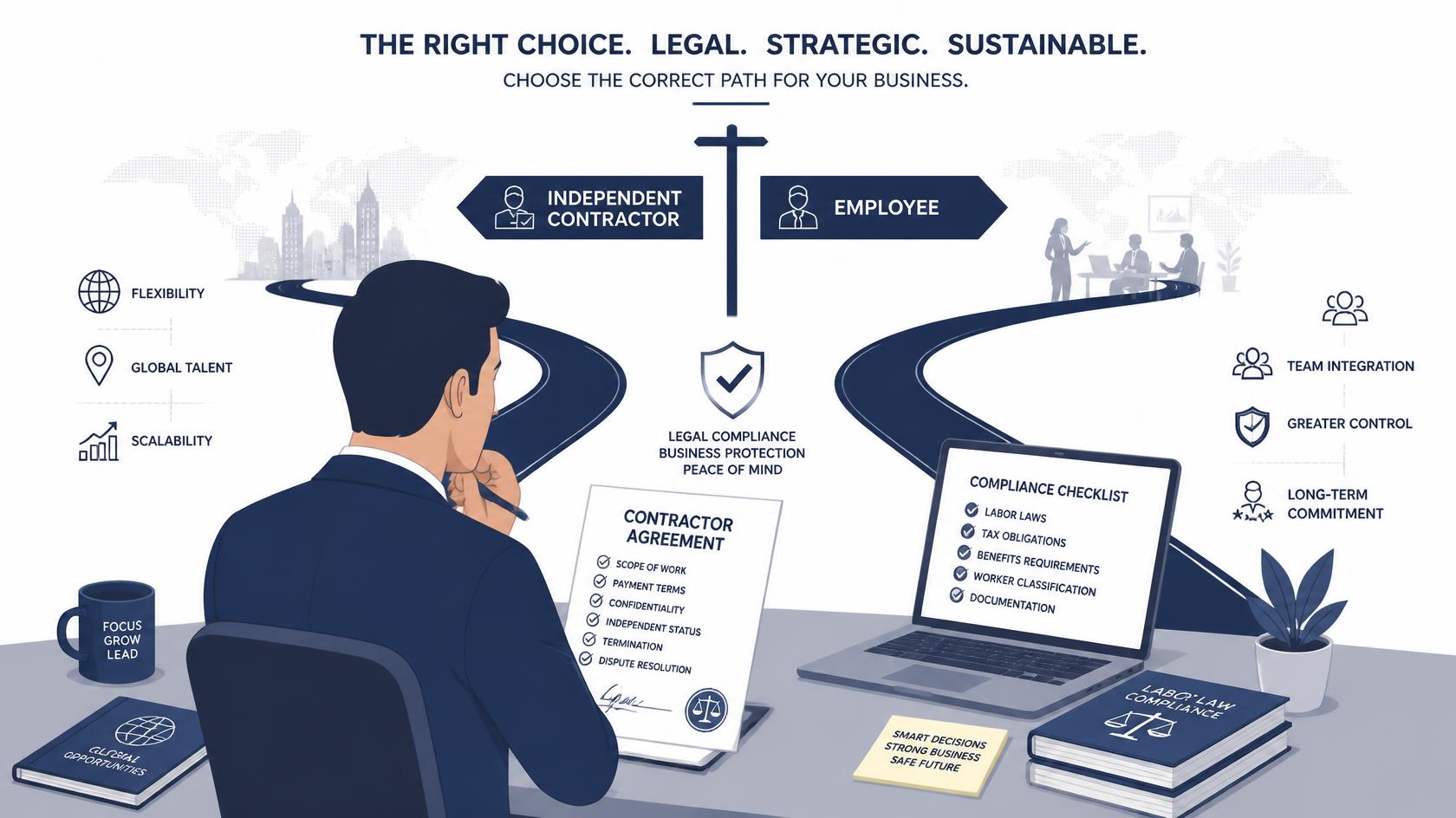
Hiring an international contractor can take less than a day.
Classifying that person correctly can take considerably longer.
That difference is where many global hiring teams get into trouble.
A company finds a developer in another country, signs an independent-contractor agreement, agrees on a monthly fee, and starts assigning work. The contract says “contractor,” invoices are submitted instead of payroll, and everyone moves on.
But a contract is not a magic compliance shield.
The more important question is what the relationship actually looks like after the contract is signed.
Who controls the worker’s schedule? Who decides how the work is performed? Can the person genuinely operate an independent business? Do they have an opportunity to make a profit or suffer a loss? Is the engagement a defined project or an indefinite role embedded in the company’s normal operations?
Those questions can matter far more than the label printed on page one of an agreement.
The U.S. Internal Revenue Service makes this point directly: worker classification depends on the full relationship and the degree of control and independence, with evidence grouped into behavioral control, financial control, and the type of relationship between the parties. The IRS also states that no single factor automatically determines status.
For companies hiring internationally, that leads to a better way of thinking about classification:
A contractor is not created by a contract. The contract has to match the reality of the relationship.
The biggest classification mistake happens after the contract is signed
Consider a hypothetical company that hires a software developer as an independent contractor.
The agreement says the developer:
- controls how services are performed;
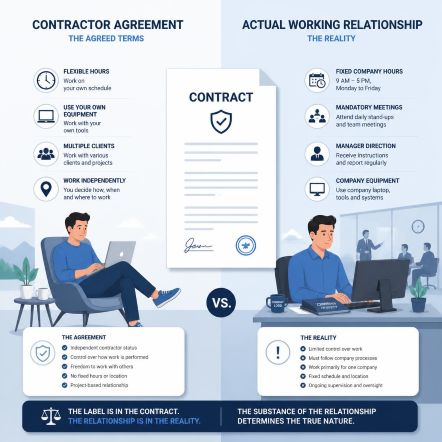 is responsible for their own equipment;
- may provide services to other businesses; and
- is engaged for a defined scope of work.
On paper, that sounds like a contractor relationship.
Six months later, however, the developer:
- works the company’s standard hours;
- reports to an engineering manager;
- attends mandatory daily stand-ups;
- receives detailed instructions about implementation;
- uses company systems and equipment;
- has no other meaningful clients;
- performs the same ongoing function as employees;
- receives new tasks every day rather than completing a defined project.
The paperwork hasn’t changed.
The relationship has.
That distinction is important because classification analysis frequently examines the actual working relationship, not simply the parties’ preferred description of it.
The IRS says a written contract identifying someone as an independent contractor is not sufficient by itself. Its guidance states that how the parties actually work together determines classification.
The Department of Labor’s current 2026 rulemaking makes a similar point in the federal wage-and-hour context: its proposed analysis would give particular importance to actual practices rather than what is merely contractually or theoretically possible.
That creates a practical compliance lesson for HR leaders:
Your contractor classification should survive an audit of what managers actually do—not just an audit of your contract templates.
2026 makes the issue even more important
Worker classification isn’t governed by one universal test.
Different laws can apply different standards, and those standards can change.
That is particularly visible in the United States right now.
On February 26, 2026, the U.S. Department of Labor announced a proposed rule that would revise its analysis for distinguishing employees from independent contractors under the Fair Labor Standards Act. The proposal would replace the 2024 rule with an economic-reality analysis centered on whether a worker is economically dependent on a potential employer or genuinely in business for themselves.
The proposal identifies two “core” factors:
- The nature and degree of control over the work
- The worker’s opportunity for profit or loss
It also identifies three additional factors:
- the skill required;
- the permanence of the relationship; and
- whether the work is part of an integrated unit of production.
The proposal is not the same thing as a final rule, and it does not replace every other classification test. In fact, the Department explicitly says the proposed rule would not determine classification under other laws that use different standards, including the Internal Revenue Code, the National Labor Relations Act, and certain state wage-and-hour laws.
That distinction is crucial for international employers.
There is no responsible global compliance shortcut that says:
“Pass these five questions and every contractor everywhere is compliant.”
The correct test depends on the applicable law.
What companies can build, however, is a repeatable classification process.
Three layers of classification risk
A useful way to evaluate contractor relationships is to look at three separate layers.
1. Legal classification
First ask:
What law applies to this worker, and what test does that law use?
The worker’s location matters. So can the nature of the services, the contracting entities, the applicable tax rules, and the jurisdiction’s employment protections.
This is where companies often make their first mistake: they use the law they know best rather than identifying the law that actually governs the relationship.
For example, the IRS’s federal tax analysis considers behavioral control, financial control, and the relationship between the parties.
That framework should not simply be copied and presented as a universal international test.
2. Operational classification
Next ask:
How is the worker actually managed?
This is where classification can quietly drift.
A contractor might begin with genuine independence but gradually become integrated into the company’s workforce.
A manager starts requiring fixed hours.
Then comes mandatory training.
Then weekly performance reviews.
Then approval requirements.
Then employee-style policies.
None of those changes necessarily decides classification by itself. But collectively, they can change the facts that a regulator or court would examine.
The IRS’s behavioral-control guidance specifically considers instructions about when, where, and how work is performed, along with training and evaluation systems. It also says that the relevant issue can be the business’s right to control, even if it does not exercise that control every day.
3. Evidence classification
Finally ask:
If someone challenged this relationship tomorrow, what would our evidence show?
This is the layer many companies overlook.
Imagine that the contractor agreement says the worker controls their schedule.
But the company’s Slack messages contain months of instructions such as:
“Please be online from 9 to 6.”
“You need to attend this mandatory team meeting.”
“Follow this exact process.”
“Your manager will review your performance next Friday.”
The issue isn’t whether any individual message proves employee status.
The issue is whether the body of evidence tells a consistent story.
A strong compliance program therefore doesn’t just store signed contracts.
It documents why the classification was made and monitors whether the underlying facts remain consistent.
Five warning signs that deserve a classification review
No single warning sign automatically turns a contractor into an employee. But these situations should trigger closer scrutiny.
1. The company controls the method, not just the outcome
A genuine business-to-business relationship can involve deadlines, specifications, quality standards, security requirements, and contractual deliverables.
Those requirements are not automatically evidence of employment.
The risk rises when the company starts directing the worker’s methods, schedule, workflow, training, and day-to-day execution in a way that resembles employee management.
The IRS specifically distinguishes control over the result from control over the means and methods used to achieve it.
2. The engagement has no real endpoint
A contractor hired for a defined project is factually different from someone engaged indefinitely to perform an ongoing internal role.
Again, duration alone does not decide classification.
But permanence is relevant in several classification frameworks. The IRS lists the expected permanence of the relationship among the factors considered under the type-of-relationship analysis.
The 2026 DOL proposal likewise identifies permanence as one of its economic-reality factors.
3. The worker has little opportunity for independent profit or loss
A genuine independent business generally has some ability to influence its commercial outcome through pricing, efficiency, investment, business decisions, or other entrepreneurial activity.
The IRS identifies opportunity for profit or loss, investment, unreimbursed expenses, availability of services to the market, and method of payment among financial-control considerations.
A contractor who simply receives a predictable wage-like payment while functioning as a dedicated employee deserves a closer look.
4. The company treats the contractor like an employee
Ask what happens operationally.
Does the contractor:
- have a manager?
- receive employee-style performance reviews?
- follow employee schedules?
- receive training on company procedures?
- have to request permission for ordinary absences?
- work exclusively for the company?
- occupy an indefinite position on an organizational chart?
None of these facts should be treated as an automatic legal test.
Together, however, they can reveal a gap between the contractual description and the actual relationship.
5. The contract and reality tell different stories
This is the most obvious red flag—and arguably the easiest one to prevent.
If the agreement says the contractor is independent but the company’s operating practices consistently contradict that description, the business has created an avoidable compliance problem.
The solution isn’t necessarily to rewrite the contract.
It may be to reconsider the relationship itself.
The classification checklist companies should use before onboarding
Instead of asking, “Can we hire this person as a contractor?”, use a more disciplined sequence.
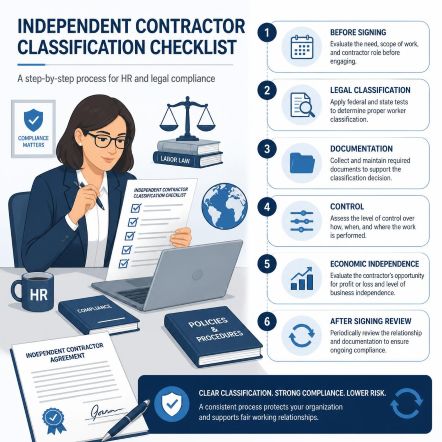 Before signing
Identify the applicable jurisdiction
Where will the worker actually perform the services?
Identify the relevant legal tests
Which employment, tax, social-insurance, and contractor rules apply?
Document the facts
Record the proposed scope, duration, payment model, working arrangements, independence, tools, expenses, and ability to work with other clients.
Analyze control
Who determines the worker’s schedule, methods, processes, and workload?
Analyze economic independence
Does the worker operate a genuine independent business with meaningful commercial autonomy?
After signing
Don’t stop the compliance process when the contract is signed.
Review whether the relationship has changed.
A simple quarterly or event-driven review can ask:
- Has the worker’s scope changed?
- Has the engagement become indefinite?
- Has management control increased?
- Are managers treating the contractor like an employee?
- Has exclusivity emerged?
- Has the payment model changed?
- Is the worker now performing an ongoing core function?
- Have local laws or regulatory requirements changed?
That last question matters particularly for global companies.
Classification is not necessarily a one-time decision.
A relationship can evolve.
Your compliance process should evolve with it.
Where a Contractor of Record can help
Companies that hire contractors across multiple countries face an additional challenge: they may understand their own hiring model but lack local expertise for every jurisdiction in which they engage talent.
A Contractor of Record (COR) model can provide a structured alternative.
Deel’s Contractor of Record service says it assesses worker classification and advises whether workers should be engaged as contractors or employees. It also describes localized contracts, contractor onboarding, global payments, and compliance support as part of its offering.
This does not mean a platform should be treated as a substitute for understanding your workforce or obtaining appropriate legal advice where needed.
It does mean companies can use specialized infrastructure to make classification and contractor administration more systematic.
That distinction matters.
The goal isn’t to find a platform that makes compliance disappear.
The goal is to reduce the number of compliance decisions that are handled inconsistently, manually, or without local context.
The real compliance test: would the evidence tell one consistent story?
This is the question that should sit at the center of any contractor compliance program:
If a regulator reviewed the contract, invoices, manager instructions, working schedule, internal communications, and day-to-day relationship together, would they tell the same story?
If the answer is yes, the company has at least created a more coherent compliance record.
If the answer is no, changing a job title or adding another paragraph to the contractor agreement probably won’t solve the underlying problem.
The best contractor relationships aren’t merely contractually independent.
They are operationally consistent with that independence.
That means:
Classify carefully.
Contract accurately.
Manage consistently.
Document the reasoning.
Review when the relationship changes.
For companies hiring internationally, that is a far stronger compliance strategy than relying on a generic contractor template and hoping the label does the work.
Want to make contractor classification more systematic?
If your company hires contractors across countries and wants a structured way to assess classification, create localized contracts, onboard contractors, and manage ongoing compliance, see how Deel’s Contractor of Record works.
See how Deel can help→ Book a Deel demo
Deel states that its Contractor of Record service assesses worker classification, advises whether workers should be contractors or employees, and provides localized contracts and contractor onboarding.
The important takeaway is simple:
A contractor agreement should document an independent relationship—not attempt to manufacture one.