Best
BestDisclosure: We are reader-supported. If you purchase from a link on our site, we may earn a commission, Learn More
Hiring Employees in Germany in 2026
The Executive Guide to Employment Law, Payroll Costs, Compliance, and Employer of Record Strategy
 Germany is one of the most strategically important hiring markets in Europe, but also one of the most operationally complex.
For global companies expanding into the European Union, Germany represents access to highly skilled engineering talent, strong enterprise capability, and one of the most stable and productive labor markets in the world. It is consistently a top-tier destination for scaling software engineering, product development, finance, and commercial teams.
However, companies entering Germany quickly encounter a second reality.
Hiring in Germany is straightforward. Employing in Germany correctly is structurally complex.
This difference defines whether a market entry strategy succeeds or becomes burdened by compliance delays, payroll inefficiencies, and unexpected employment costs.
Germany is not a flexible labor market. It is a regulated employment system where legal frameworks define how employment must operate.
This guide breaks down what global companies must understand before hiring in Germany in 2026, including employment law structure, payroll systems, total employment cost, statutory benefits, termination rules, contractor risk, and how Employer of Record (EOR) models are used to simplify market entry.
Why Companies Hire in Germany
Germany remains one of the most attractive hiring destinations in Europe due to a combination of talent quality, economic strength, and geographic positioning.
The German workforce benefits from a dual education system that integrates academic learning with vocational training. This produces professionals who are technically strong, process-oriented, and experienced in structured enterprise environments.
 Germany is particularly strong in:
- Software engineering and distributed systems
- Automotive and industrial engineering
- Cybersecurity and infrastructure architecture
- Enterprise SaaS and B2B platforms
- Financial services and regulated industries
Beyond talent, Germany’s central position in Europe makes it a natural hub for regional expansion across EU markets.
However, these advantages come with structured labor protections and regulatory obligations that materially impact hiring strategy.
The German Employment System: A Structured Legal Framework
Employment in Germany is governed by multiple overlapping legal systems:
- Federal labor law (Arbeitsrecht)
- Tax law (Einkommensteuerrecht)
- Social insurance regulations
- Collective bargaining agreements (Tarifverträge)
- Works council co-determination rules (Betriebsrat, where applicable)
Unlike flexible employment markets, Germany does not rely on fully negotiable employment terms. Instead, most employment conditions are defined by statutory requirements.
Employers must comply with rules governing:
- Employment contracts and classification
- Working time regulations
- Payroll and tax reporting
- Mandatory social contributions
- Paid leave entitlements
- Sick leave compensation
- Parental leave protections
- Termination procedures and notice periods
This creates a system where employment is not purely an HR function, but a regulated operational structure.
Key Insight
Employment in Germany is not designed freely by companies—it is executed within a predefined legal framework.
The Real Cost of Hiring in Germany
One of the most common mistakes global companies make when entering Germany is underestimating total employment cost.
Salary alone does not represent total cost.
Employers are required to contribute to Germany’s mandatory social insurance system, which funds healthcare, pensions, unemployment insurance, and long-term care.
These contributions are mandatory and structured by law.
Employer Cost Breakdown (Typical Structure)
| Cost Component | Description | Employer Responsibility |
|---|---|---|
| Base Salary | Employee gross compensation | Contractual |
| Pension Insurance | Retirement system | Mandatory contribution |
| Health Insurance | Public healthcare system | Shared contribution |
| Unemployment Insurance | Job protection system | Shared contribution |
| Long-Term Care Insurance | Elder care system | Shared contribution |
| Accident Insurance | Workplace injury coverage | Employer-funded |
Real Cost Example (Mid-Level Employee)
| Category | Annual Cost |
|---|---|
| Base Salary | €80,000 |
| Employer Social Contributions | €16,000 – €22,000 |
| Total Employment Cost | €96,000 – €102,000+ |
This excludes:
- Bonuses
- Equity compensation
- Equipment and overhead
- Recruitment costs
- Relocation benefits
Strategic Cost Insight
Germany typically increases total employment cost by 20%–35% above base salary.
This has direct impact on:
- Headcount planning
- Budget forecasting
- Hiring velocity
- Market entry timelines
- ROI modeling for EU expansion
Most hiring miscalculations in Germany occur at this stage.
Payroll in Germany: A Government-Integrated System
Payroll in Germany is not simply salary processing.
It is a regulated reporting infrastructure connected directly to government systems.
Employers must calculate and submit:
- Income tax withholding via ELStAM
- Social insurance contributions
- Health insurance payments
- Pension fund contributions
- Monthly statutory reporting
Each employee is continuously tracked across tax and insurance systems.
Payroll System Complexity Overview
| Function | Requirement | Risk if Incorrect |
|---|---|---|
| Income Tax | ELStAM classification | Tax audits |
| Social Insurance | Monthly contributions | Financial penalties |
| Reporting | Government filings | Compliance violations |
| Payslips | Legal format compliance | Employee disputes |
Operational Reality
Payroll in Germany is not a standalone HR task.
It is an ongoing compliance function that must remain aligned with government systems at all times.
As companies scale, payroll becomes exponentially more complex because each additional employee introduces new classification, reporting, and contribution requirements.
This is why many companies rely on localized payroll providers or Employer of Record infrastructure when entering Germany.
Mandatory Employment Benefits and Protections
Germany has one of the strongest statutory employee protection frameworks in Europe.
These protections cannot be removed or reduced through contracts.
Paid Leave
Employees are entitled to statutory minimum vacation days, typically exceeding international standards in practice.
Sick Leave Protection
Employees receive continued salary payments during illness under regulated insurance systems.
Parental Leave
Employees are entitled to structured parental leave with job protection guarantees and defined benefit frameworks.
Notice Periods
Notice periods increase based on tenure and can extend significantly for long-term employees.
Notice Period Table
| Tenure | Typical Notice Period |
|---|---|
| < 2 years | ~1 month |
| 2–5 years | 1–2 months |
| 5–10 years | 2–3 months |
| 10+ years | Up to 6 months |
Strategic Impact
This system creates workforce stability but reduces flexibility in restructuring or rapid scaling scenarios.
Works Councils and Co-Determination
In many German organizations, works councils (Betriebsrat) play a formal role in workplace governance.
Where present, works councils may have consultation or co-determination rights over:
- Hiring decisions
- Working conditions
- Organizational restructuring
- Internal policy changes
- Termination processes
While they do not block hiring, they introduce an additional governance layer that can affect execution speed and HR workflows.
International companies often underestimate this operational dimension during early expansion.
Contractor Misclassification Risk in Germany
Some companies attempt to reduce complexity by using independent contractors.
In Germany, this introduces significant legal risk.
Authorities evaluate employment based on substance over contract structure.
Risk Indicators
- Fixed working hours
- Direct reporting relationships
- Integration into internal teams
- Single-client dependency
- Use of company systems
Legal Consequences
| Risk Area | Outcome |
|---|---|
| Tax exposure | Back taxes + interest |
| Social contributions | Retroactive payments |
| Legal claims | Employment lawsuits |
| Penalties | Regulatory fines |
Germany is considered one of the strictest enforcement jurisdictions in Europe for classification risk.
Entity Setup vs Employer of Record (EOR)
Companies hiring in Germany must choose between two structural models.
Option 1: Local Entity Setup
This provides full operational control but requires:
- Legal incorporation in Germany
- Tax registration and compliance setup
- Payroll infrastructure implementation
- Local HR and legal resources
- Ongoing administrative overhead
Best for:
- Large-scale hiring operations
- Long-term EU headquarters strategy
- Mature compliance infrastructure
Option 2: Employer of Record (EOR)
An Employer of Record allows companies to hire in Germany without establishing a legal entity.
The EOR becomes the legal employer while the company manages day-to-day work.
EOR Capability Overview
| Capability | Description |
|---|---|
| Legal Employer | EOR assumes employment responsibility |
| Payroll | Fully compliant processing |
| Benefits | Statutory administration |
| Contracts | Locally compliant agreements |
| HR Ops | End-to-end onboarding support |
Strategic Comparison
| Factor | EOR | Entity |
|---|---|---|
| Speed | Days | Months |
| Compliance burden | Low | High |
| Upfront investment | Low | High |
| Scalability | Medium | High (at scale) |
For most companies hiring fewer than 10–15 employees in Germany, EOR is typically the fastest and most efficient entry model.
How Deel Helps Companies Hire in Germany
Deel enables companies to hire employees in Germany without establishing a local entity.
Through its Employer of Record infrastructure, Deel manages:
- Locally compliant German employment contracts aligned with labor law
- Payroll processing integrated with German tax and social insurance systems
- Mandatory benefits administration (health, pension, insurance contributions)
- Ongoing compliance monitoring across the employee lifecycle
- Structured onboarding workflows tailored to German regulations
This allows companies to focus on hiring and performance management while reducing exposure to legal, payroll, and compliance complexity.
More importantly, Deel enables companies to enter the German market quickly without waiting months for entity formation—an advantage that directly impacts hiring speed and competitive positioning.
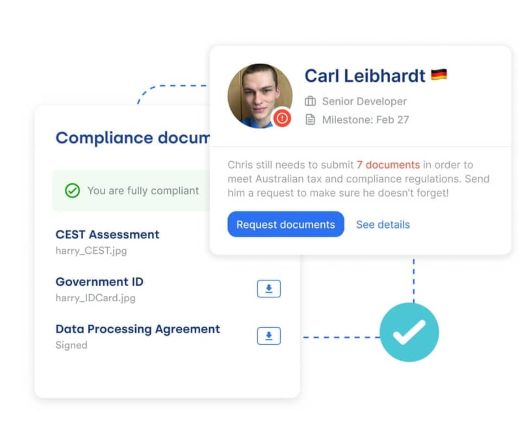
If your company is planning to hire in Germany, Deel’s EOR model provides a fast, compliant path to onboard employees without establishing a local entity.
Final Thoughts: Germany Requires an Employment Strategy, Not Just Hiring
Germany is one of the strongest hiring markets in Europe, but also one of the most structured employment systems globally.
Success in Germany depends on understanding:
- True total employment cost
- Payroll and tax integration systems
- Statutory employment protections
- Termination frameworks and notice periods
- Regulatory compliance obligations
Companies that succeed in Germany treat it not as a recruitment destination, but as a regulated employment system that must be designed into their operating model.
For global organizations, the key question is not whether they can hire in Germany, but how they can do so in a way that is fast, compliant, and scalable.
For many companies, Employer of Record solutions such as Deel provide the most efficient pathway to building teams in Germany without the complexity of local entity setup—while maintaining full compliance from day one.
Frequently Asked Questions
Can a foreign company hire employees in Germany without opening a local entity?
Yes. Companies can hire employees through an Employer of Record (EOR), which acts as the legal employer while the company manages the employee’s day-to-day work.
How long does it take to hire employees in Germany through an EOR?
Most EOR providers can onboard employees within days, whereas establishing a local entity and setting up payroll infrastructure can take several weeks or months.
Can I hire independent contractors instead of employees in Germany?
Companies can engage contractors, but Germany strictly enforces worker classification rules. Misclassification can lead to back taxes, social contribution liabilities, penalties, and legal claims.
Is payroll in Germany complicated?
Yes. Employers must manage income tax withholding, social insurance contributions, health insurance payments, pension contributions, and ongoing government reporting requirements.
Ready to Hire in Germany?
Deel helps global companies hire, onboard, and manage employees in Germany through a fully compliant Employer of Record solution.
Book a Deel demo today to calculate your total employment cost in Germany and determine the fastest, most compliant way to start hiring.