Best
BestDisclosure: We are reader-supported. If you purchase from a link on our site, we may earn a commission, Learn More
The AI Hiring Gap: Finding Global Talent Is Getting Easier. Employing It Isn't.

AI Has Solved One Hiring Problem. It Has Exposed Another.
For years, companies complained that finding the right people was too difficult.
The talent was out there, but recruiting teams had limited ways to find it. Geography narrowed the search. Hiring managers relied heavily on networks. Recruiters spent hours sorting applications, coordinating interviews and trying to determine whether a candidate’s experience matched a job description.
AI is changing that equation.
A recruiter can now search more intelligently, process large volumes of candidate information, identify skills buried in resumes and automate parts of the administrative work that once consumed entire days.
But there is a catch.
The easier it becomes to find someone anywhere in the world, the more obvious the limitations of the employment infrastructure behind the hire become.
That is the AI hiring gap.
The front of the funnel is getting faster.
The rest of the organization has to catch up.
The Talent Market Is Expanding Faster Than the Old Hiring Model
The World Economic Forum’s Future of Jobs Report 2025 projects 170 million new jobs and 92 million displaced jobs by 2030, for a net increase of 78 million. More than 1,000 employers contributed to the research, and the report identifies AI and big data as the fastest-growing skills.
The headline is about job creation and displacement.
The more interesting implication for hiring is about where the necessary skills will be found.
If companies need more specialized technical talent while those skills are unevenly distributed around the world, hiring becomes less about filling a seat in a particular office and more about accessing a particular capability.
That changes the role of geography.
It doesn’t eliminate geography. Employment laws, tax rules and worker protections remain stubbornly local.
But geography is becoming less useful as a talent filter.
A company may no longer ask:
Where can we hire?
It can ask:
Where is the person who can solve this problem?
That is a much bigger question.
And AI is helping companies ask it at scale.
AI Isn’t Replacing the Recruiter. It’s Changing the Search.
The most useful applications of AI in recruiting are often less dramatic than the headlines suggest.
AI can help with work such as:
- identifying relevant candidates;
- matching skills to roles;
- summarizing candidate information;
- generating interview questions;
- organizing recruiting workflows;
- automating routine communications;
- highlighting information that deserves human attention.
None of that means a hiring manager can hand the employment decision to a model and walk away.
In fact, regulation is moving in the opposite direction.
Under the EU AI Act framework, certain AI systems used for recruitment and selection can be classified as high-risk. The EU’s AI Act Service Desk specifically identifies automated job-matching and candidate-ranking systems among the employment use cases that can fall within the high-risk category.
That distinction matters.
AI can make the search more efficient.
It doesn’t make the organization less accountable for the decision.
A sensible division of labor looks something like this:
AI handles information.
Humans handle judgment.
The organization owns the outcome.
That last part is the one companies should not automate away.
Then Something Interesting Happens
Imagine a startup is looking for an AI engineer.
Its recruiting system finds an exceptional candidate.
The candidate is based in another country.
The hiring manager wants to proceed.
The recruiter has done their job.
But the company now has a new set of questions:
- What is the appropriate way to engage this person?
- Does the company have the right employment structure?
- What should the contract look like?
- How will payroll work?
- What statutory requirements apply?
- What benefits are required?
- How should onboarding happen?
- Who manages the employment relationship?
- What happens when local employment rules change?
None of those questions were answered by finding the candidate.
And that is the central problem with the way we often talk about AI hiring.
We treat recruiting and employment as if they were the same workflow.
They aren’t.
AI can get a candidate to the edge of the organization.
Something else has to get them inside it.
The Rise of the Global AI Worker
There is already evidence that AI is creating demand for talent that doesn’t necessarily sit in the same country as the companies building AI products.
Deel’s 2026 Global Hiring Report analyzed more than one million worker contracts across 37,000+ companies in 150+ countries. Among its findings: general AI-trainer roles grew 283% in cross-border hiring in 2025. Deel says the category now spans more than 70,000 workers across 600+ organizations.
That’s more than an interesting labor-market statistic.
It tells us something about how AI development actually works.
AI systems need human expertise.
They need people who can evaluate outputs, provide feedback, label or assess information, and contribute specialized knowledge.
And that expertise is global.
A medical expert doesn’t need to live in Silicon Valley to contribute to an AI system.
A linguist doesn’t need to live in the country where the AI company is headquartered.
A subject-matter expert can be valuable precisely because they bring knowledge that isn’t concentrated in the company’s home market.
AI is therefore doing something slightly counterintuitive.
It is creating a technology that increases the value of human expertise—and simultaneously expanding the geography from which companies can recruit that expertise.
That’s why global hiring is becoming a strategic issue for AI companies.
The New Bottleneck Is Infrastructure
This is where I think the conversation about AI hiring needs to mature.
The question is no longer simply:
How much of recruiting can we automate?
It is:
Can the rest of the company keep up with the talent the recruiting system can find?
Consider a business that can efficiently source candidates in 50 countries but has practical employment operations in only a handful.
Its recruiting capability is ahead of its employment capability.
 That’s an infrastructure gap.
And the gap can become expensive.
A candidate may accept another offer while a company works through employment arrangements.
A hiring manager may reject a strong international candidate simply because the organization doesn’t know how to employ them.
A growing company may end up managing payroll providers, local advisers, contracts and HR processes across a collection of countries that were never part of the original operating plan.
None of these problems are particularly glamorous.
All of them can determine whether a company actually gets the person it wanted.
Think of Hiring as a Stack, Not a Single Tool
The modern hiring workflow increasingly looks like five connected layers.
1. Discover
AI helps identify candidates and talent markets.
The question: Where is the capability we need?
2. Evaluate
Technology helps organize evidence and reduce administrative work.
The question: Who deserves serious consideration?
3. Decide
Recruiters and hiring managers apply judgment.
The question: Should we hire this person?
4. Employ
The organization establishes the appropriate employment relationship and handles the relevant country requirements.
The question: Can we hire this person correctly?
5. Operate
Payroll, benefits, HR and workforce processes support the relationship after the hire.
The question: Can we manage this person reliably?
The first two layers are where AI gets most of the attention.
The last three are where the business risk lives.
This Is Where Deel Becomes Relevant
Deel’s role makes more sense when viewed through that entire workflow.
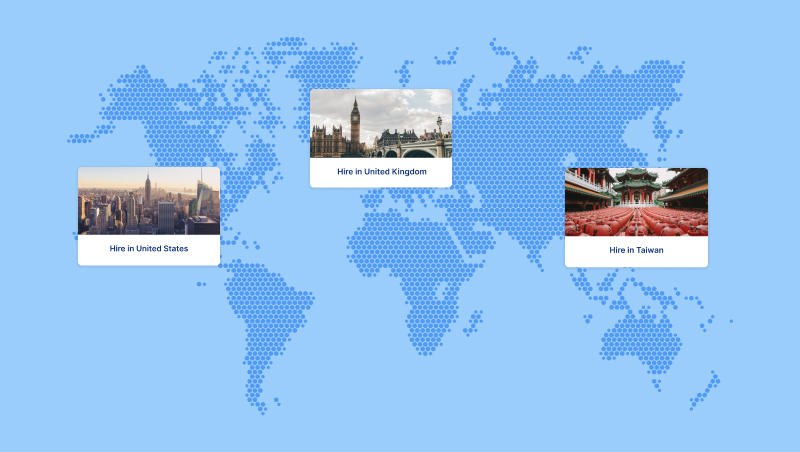
The company’s current platform spans global hiring, payroll, HR and related workforce operations, with coverage across more than 150 countries. Its 2026 Global Hiring Report is based on data from more than one million worker contracts across 37,000+ companies in 150+ countries.
That makes Deel relevant to a problem that starts after an AI recruiting system has done its job.
A company has found someone.
Now it needs to turn that decision into an employment relationship.
That’s the infrastructure layer.
And this is a much more interesting role for a platform like Deel than simply saying it “helps companies hire globally.”
The real value is reducing the distance between:
We found the person.
and
They’re now part of the workforce.
For a company hiring internationally at scale, that distance can represent considerable operational complexity.
The recruiting technology can find the opportunity.
The employment infrastructure determines whether the company can act on it.
The Best AI Hiring Strategy May Be Less About Automation Than Connectivity
There is a tendency to think the future of hiring is one giant AI recruiter.
It will source candidates.
Screen them.
Interview them.
Make an offer.
Done.
Real organizations are messier than that.
The future is more likely to be a connected stack of systems, with AI sitting across parts of the workflow.
Something like:
Talent Discovery (AI) → AI-Assisted Evaluation → Human Decision → Employment Setup → Payroll → Onboarding → Ongoing Workforce Management
The strategic question is whether those layers can communicate with each other.
Because a faster first step doesn’t necessarily produce a faster hire.
If recruiting becomes ten times more efficient but employment operations remain fragmented, the bottleneck simply moves.
The organization finds people faster.
Then waits longer to hire them.
What HR Leaders Should Measure Next
Traditional recruiting metrics—time to hire, cost per hire, offer acceptance—still matter.
But global AI-assisted hiring creates another set of questions.
1. How many countries can we actually hire in?
Not theoretically.
Operationally.
2. How quickly can we turn an international candidate into an employee or contractor?
That is a measure of infrastructure, not sourcing.
3. Where does AI make decisions, and where does a human remain accountable?
This becomes increasingly important as AI enters consequential employment workflows.
4. How many systems does one international hire require?
If the answer is “a spreadsheet, three vendors, two advisers and a dozen manual steps,” the company has an infrastructure problem.
5. What happens when our best candidate lives somewhere we’ve never hired before?
This may be the most revealing question of all.
Because the answer tells you whether your global talent strategy is real—or theoretical.
The Companies With the Most Talent Access May Not Have the Best Recruiting Technology
They may simply have fewer constraints.
That’s an important distinction.
Two companies can use exactly the same AI recruiting software.
One can consider candidates across dozens of countries.
The other limits its search to places where it already has the infrastructure to employ people.
The difference isn’t necessarily the AI.
It’s the operating model behind it.
This is why I expect employment infrastructure to become a bigger part of talent strategy as AI-powered recruiting matures.
When talent discovery becomes increasingly borderless, the ability to employ talent becomes a competitive capability.
AI Makes the World Smaller. Employment Law Doesn’t.
That’s ultimately the paradox.
AI can search globally in seconds.
Employment rules remain local.
A model can identify the best candidate regardless of their postcode.
A company still has to deal with the jurisdiction attached to that person.
That isn’t a flaw in the system.
It’s simply the reality of global employment.
And it means the future of hiring isn’t going to be purely technological.
It will be a combination of:
AI for scale.
Humans for judgment.
Employment infrastructure for execution.
Governance for accountability.
Companies that connect those four elements will have a significant advantage over companies that optimize only the first.

The Real AI Hiring Revolution Happens After “Yes”
The most important consequence of AI in hiring may not be that recruiters can process more resumes.
It may be that companies can seriously consider candidates they would previously never have found.
That changes the economics of talent.
But it also changes the responsibilities that come afterward.
If AI expands the talent pool, companies need employment infrastructure capable of supporting that expanded pool.
If AI creates new categories of work, companies need ways to engage the people doing it.
If AI makes global recruiting easier, payroll and compliance can’t remain an afterthought.
The winning companies won’t necessarily be the ones with the most automation.
They’ll be the ones that can move from:
“We found someone exceptional.”
to:
“We can hire them.”
quickly, responsibly and at scale.
That’s the real AI hiring gap.
And closing it may become one of the defining HR challenges of the next few years.
Can Your Company Act on the Talent AI Finds?
If your recruiting strategy is increasingly global, the question isn’t only whether you can discover exceptional candidates.
It’s whether your employment infrastructure can keep up.
See how Deel enables global hiring
Deel’s current global hiring offering is designed to support organizations hiring and managing workers across 150+ countries.
The strategic question is simple:
If AI finds your next great hire somewhere in the world, are you ready to employ them?