 Best
Disclosure: We are reader-supported. If you purchase from a link on our site, we may earn a commission, Learn More
Deel vs. Rippling Comparison: Which Platform Fits Your Global Workforce?
Hiring internationally is easier than it used to be. Managing an international workforce is another matter.
A company might employ staff in the United States, hire a specialist in Germany, and work with independent contractors in India and Brazil. Each arrangement brings different administrative requirements, from employment contracts and payroll to contractor invoices and local compliance.
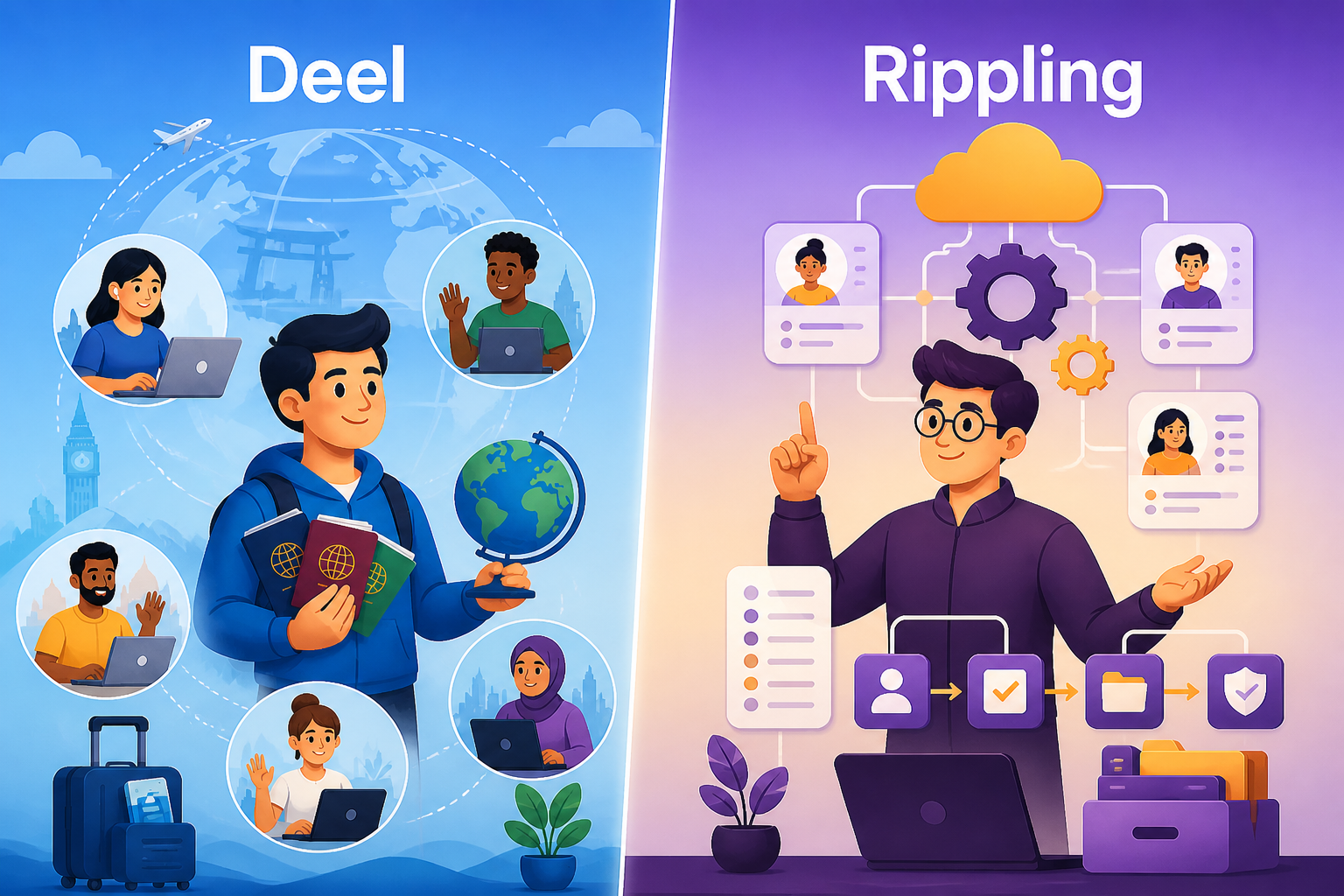
Deel and Rippling both help businesses manage these responsibilities. But they approach the problem from different starting points.
Deel has built a substantial business around international employment, contractor management, and global payroll. Rippling connects HR and payroll with IT, devices, and other business operations. Both platforms have expanded beyond their original strengths, making a simple feature-count comparison less useful than understanding how each fits your business.
The short answer: Start with Deel if international hiring and cross-border workforce administration are your main challenges. Start with Rippling if you want HR, payroll, and IT operations connected through one platform. If you need both, compare their actual capabilities, country coverage, and total cost before deciding.
Deel vs. Rippling: At a Glance
| Category | Deel | Rippling |
|---|---|---|
| Core positioning | Global employment and workforce management | Connected HR, payroll, IT, and business operations |
| Employer of Record (EOR) | Available | Available |
| Global payroll | Available for supported countries and arrangements | Available for supported countries and arrangements |
| Contractor management | Available, including international payment workflows | Available |
| HR management | Available | Available |
| IT and device management | Available through Deel IT offerings | A central part of its broader platform |
| Finance and spend management | Workforce-related financial capabilities; verify specific needs | Finance and spend-management products available |
| Strongest reason to evaluate | International hiring and varied worker arrangements | Connecting employee records with HR and IT workflows |
| Pricing approach | Varies by product and service | Varies by selected products and configuration |
| Key consideration | Country coverage, employment arrangements, and service scope | Module selection, integrations, and overall platform cost |
Deel: When International Workforce Management Comes First
International expansion creates decisions that a standard HR system may not solve by itself.
Before hiring in another country, a company needs to establish how the worker will be engaged. Does the business have a suitable local entity? Does it need an Employer of Record? Will employees be paid through the company’s own entities? How will independent contractors be onboarded and paid?
Deel offers products covering EOR, global payroll, contractor management, HR, and other workforce services. That breadth makes it relevant to companies managing several employment arrangements across different markets.
Consider a growing software company with employees in the United States, a new hire in Germany, and independent contractors in several other countries. The company might use its US entity for domestic employees, evaluate an EOR arrangement for the German hire, and use contractor-management tools for its independent professionals.
These are different operational needs, but they all sit within the broader problem of managing an international workforce.
Deel is worth evaluating when coordinating these arrangements has become a regular responsibility for HR, finance, or operations rather than an occasional administrative task.
Where Deel stands out as a starting point
- Businesses hiring internationally without immediately establishing local employing entities.
- Companies managing independent contractors across borders.
- Payroll teams coordinating employees in multiple countries.
- Organizations seeking a provider with a strong focus on international workforce operations.
Deel also offers HR and IT-related products. It should not be evaluated solely as an EOR or contractor-payment service. The relevant question is whether its specific products fit the company’s existing systems and operating model.
Rippling: When HR and IT Need to Work Together
For many businesses, the main workforce challenge is not entering a new country. It is keeping internal systems synchronized.
A new employee joins. HR creates the employee record, IT prepares a laptop, application accounts need to be provisioned, and payroll needs the correct information. When someone changes roles or leaves, those processes must be updated again.
If each department works in a separate system, routine changes create repeated handoffs and opportunities for mistakes.
Rippling’s platform is designed to connect employee information with HR, payroll, IT, and other business functions. Depending on the products selected, employee changes can drive related workflows across the organization.
This integrated approach is particularly relevant to businesses that want to consolidate tools rather than manage HR, payroll, device administration, and access management separately.
Rippling also offers international workforce services, including EOR, global payroll, and contractor-related products. It is therefore a genuine alternative to Deel for several global hiring use cases.
Where Rippling stands out as a starting point
- Businesses connecting employee onboarding with device and application access.
- HR and IT teams managing too many disconnected systems.
- Companies consolidating selected HR, payroll, IT, and finance tools.
- Organizations that want international workforce capabilities within a broader operational platform.
The important caveat is that platform breadth does not automatically mean better value. The business should determine which modules it needs and whether the proposed configuration solves problems it actually has.
EOR vs. Global Payroll vs. Contractor Management
These three services are frequently grouped together in workforce-platform comparisons. They solve different problems, and choosing the wrong service can create unnecessary costs or operational complications.
| Service | What it means | When you need it |
|---|---|---|
| Employer of Record (EOR) | A provider legally employs a worker on behalf of a client company under an agreed arrangement | You want to hire an employee in a country where your company lacks a suitable employing entity |
| Global payroll | A service supporting payroll administration for employees across countries | Your company already employs workers through its own entities and needs to coordinate payroll internationally |
| Contractor management | Tools and services for administering independent contractors, including agreements, invoices, and payments | Your business engages genuine independent professionals across borders |
Employer of Record (EOR)
An Employer of Record legally employs a worker on behalf of a client company in a country where the client does not have its own suitable employing entity.
Depending on the arrangement, the provider may manage employment agreements, payroll, statutory contributions, benefits administration, and other agreed responsibilities. The client generally directs the worker’s day-to-day work, subject to the applicable law and contract.
EOR can help a company hire internationally without immediately establishing a local employing entity. Both Deel and Rippling offer EOR services.
Before choosing a provider, confirm which entity will employ the worker, which countries are supported, what benefits are included, and which responsibilities remain with your business.
Using an EOR does not automatically eliminate every employment-law or permanent-establishment risk. The actual working arrangement and business activities still matter.
Which should you choose? Evaluate Deel first if international EOR hiring is your main priority. Consider Rippling if you also want the employment workflow connected with your internal HR and IT operations.
Global payroll
Global payroll serves companies that employ workers through their own entities and need to administer payroll across countries.
Depending on the service and country, this may include payroll calculations, deductions, payslips, statutory reporting, payment coordination, and related administration.
Outsourcing payroll processing does not automatically transfer all employer responsibilities to the provider. Your company may retain responsibility for approvals, filings, payments, and other obligations under the agreement.
Both Deel and Rippling offer global payroll capabilities. Their suitability depends on the countries required, the service model available in each market, reporting needs, and integrations with existing finance systems.
Which should you choose? Compare both providers against your actual country list. Ask each to explain what it handles locally, what your team must still do, and how exceptions or payroll corrections are managed.
Contractor management
Contractor management helps businesses administer independent professionals through workflows such as onboarding, agreements, invoice approvals, and payments.
Both platforms offer contractor-related services. The important differences to investigate include supported countries, payment methods, currencies, onboarding requirements, and the amount of manual work left to your team.
Contractor management is not the same as EOR. A company cannot make an employment relationship compliant simply by labelling a worker a contractor.
A Contractor of Record service is also distinct from ordinary contractor-management software because it may involve a provider accepting specific contractual responsibilities for the engagement.
Which should you choose? Deel is a natural starting point when cross-border contractor administration is central to your business. Rippling is also worth evaluating if you want contractor workflows connected to your broader workforce platform.
Which Platform Fits Your Actual Workflow?
Feature lists matter, but the best way to compare Deel and Rippling is to examine what your team needs to accomplish.
| Business scenario | Recommended starting point | Why |
|---|---|---|
| Hiring employees abroad without establishing local entities | Deel | Its international employment offering aligns closely with this requirement |
| Managing contractors in multiple countries | Deel | Its global workforce and contractor-management capabilities are relevant |
| Paying employees through existing foreign entities | Compare both | Country coverage and payroll delivery determine suitability |
| Connecting onboarding with devices and application access | Rippling | Its integrated HR and IT approach directly addresses this workflow |
| Consolidating HR, payroll, IT, and finance processes | Rippling | Its broader platform is designed to connect these functions |
| Managing global employment and complex internal IT workflows | Compare both | You need to weigh international service coverage against platform integration |
These recommendations indicate where to begin, not which vendor will always win.
For example, an internationally distributed startup with few internal IT requirements may value Deel’s global workforce capabilities more than an extensive internal operations platform. A company with an established domestic workforce, multiple IT systems, and a smaller international hiring requirement may place greater value on Rippling’s connected workflows.
A company with both needs should evaluate the two against the same practical scenarios rather than assume it must choose based on brand positioning alone.
Pricing: Compare the Whole Operating Cost
The lowest advertised price is not necessarily the lowest-cost solution.
An EOR service, a contractor-management subscription, and a global payroll service are different products. Comparing their prices without accounting for what each includes can lead to the wrong conclusion.
Both Deel and Rippling offer different products and configurations. Actual costs depend on the services selected, workforce size, countries, and contractual terms.
| Cost factor | Questions to ask |
|---|---|
| Workforce size | How many employees, contractors, and EOR workers will be covered? |
| Country coverage | Which current and planned markets are included? |
| Product scope | Are EOR, payroll, contractor management, HR, and IT included or priced separately? |
| Implementation | Are there setup, migration, training, or integration costs? |
| Additional charges | Do payment fees, foreign exchange costs, benefits, or third-party services apply? |
| Contract terms | What are the minimum commitments, renewal conditions, and termination provisions? |
Ask both vendors to quote the same workforce scenario. Include your current systems and the tools you could realistically replace.
A broader platform may justify its cost if it reduces enough administrative work or eliminates duplicate software. But paying for features your team rarely uses can increase costs without improving operations.
The right comparison is total cost against the actual work the platform will take off your team’s hands.
Questions to Ask Before Signing
A polished demonstration does not necessarily reveal how a platform handles exceptions, local requirements, or everyday administrative work.
Ask both providers to demonstrate the same scenarios and answer these questions:
| Area | Questions to ask |
|---|---|
| EOR | Which entity employs the worker, and which responsibilities are included? |
| Global payroll | Who handles calculations, filings, payments, and corrections in each country? |
| Contractor management | Which onboarding, agreement, invoice, and payment workflows are supported? |
| Integrations | Can the platform connect with our current HR, finance, IT, and identity systems? |
| Implementation | What setup, migration, and training will our team need? |
| Security | How are access permissions, data exports, and employee offboarding handled? |
| Support | What support arrangements apply in our countries and time zones? |
| Total cost | What will the first year and subsequent years cost under the proposed configuration? |
The answers will reveal more about operational fit than a generic feature checklist. They also give you a consistent basis for comparing proposals.
Final Verdict: Deel vs. Rippling
There is no universal winner because Deel and Rippling address overlapping but different operational priorities.
Start with Deel if international employment and cross-border workforce administration are your main challenges. Its EOR, global payroll, and contractor-management offerings make it relevant to businesses coordinating different worker arrangements across countries.
Start with Rippling if connecting HR, payroll, IT, and finance operations is your main challenge. Its integrated approach is relevant to businesses that want employee information to drive processes across several internal systems.
If both priorities matter equally, compare both platforms using the same countries, worker arrangements, workflows, and pricing assumptions. Verify service availability and contractual responsibilities before committing.
The better platform is not necessarily the one with more features. It is the one that meets your requirements without introducing unnecessary cost or complexity.
Explore Deel for Your Global Workforce
If your business is expanding internationally, hiring through EOR, or managing contractors across borders, Deel is worth evaluating against your specific requirements.
Review the services available for your countries and request a demonstration based on your current workforce, payroll arrangements, and expansion plans.
See How Deel Supports Your Global Workforce →

Before booking, prepare your country list, worker types, and current payroll requirements. This will help you assess whether Deel fits your business rather than relying on a generic product demonstration.